
< class='av-special-heading-tag ' itemprop="headline" >E-invoicing and E-Reporting in France

From September 2026, France will introduce a new requirement for electronic invoicing and e-reporting. We can help you meet these requirements on time, without the need for cloud migration or being tied to a specific provider.

Why now: the requirement comes into force in September 2026

With the ‘Réforme Facture Électronique’, France is introducing one of the most comprehensive continuous transaction control models in Europe. The reform is being rolled out in phases:

  • 1. September 2026: Alle mehrwertsteuerpflichtigen Unternehmen in Frankreich müssen elektronische Rechnungen empfangen können. Große und mittlere Unternehmen müssen elektronische Rechnungen ausstellen und E-Reporting übermitteln.
  • 1. September 2027: Die Ausstellungs- und Meldepflicht gilt auch für KMU und Kleinstunternehmen.

Relevant ist das für drei Kategorien von Transaktionen:

E-invoicing (domestic B2B):

Invoices between French companies must be exchanged in a structured format (UBL 2.1, CII or Factur-X) via a state-accredited Plateforme Agréée (PA). Paper and plain PDFs are no longer permitted.

E-reporting (B2C and cross-border):

There is a specific reporting obligation to the French tax authorities (DGFiP) for B2C sales, cross-border B2B transactions and certain payment data. This also applies to foreign companies with a French VAT number.

Lifecycle status and payment details:

For each e-invoice, the defined status in the invoice lifecycle (receipt, approval, rejection, payment) must be transmitted in a structured format.

But beware of further changes

Many technical and legal details are still subject to change even at the start of 2026. Under the 2026 Finance Act, the previous term ‘PDP’ has been officially replaced by ‘Plateforme Agréée’ (PA), penalties have been tightened, and certain concessions (such as those relating to international incoming invoices) have been introduced. Further clarifications are likely before the go-live. That is precisely why two things matter today: a clean architecture and a partner who is on board when the rules change.

The EPO solution at a glance

EPO offers two complementary solution components that cover the two regulatory pillars of the reform. Both are modification-free ABAP add-ons that integrate seamlessly with ECC and S/4HANA and do not require cloud migration.

Component 1: EPO Lifecycle Monitor

Status tracking for every e-invoice in SAP. The current status (receipt, approval, rejection, payment status) of the invoice is determined by status messages sent or received. Our monitor automatically handles the sending and receiving of messages to and from the Plateforme Agréée via your provider.

The EPO Lifecycle Monitor includes the following:

  • Capture of all status messages relevant to tax obligations (CDAR) from SAP FI and SD
  • Automatic transmission to, and receipt from, the selected approved platform
  • A self-contained, complete audit trail in the Lifecycle Monitor

Component 2: EPO E-Reporting France

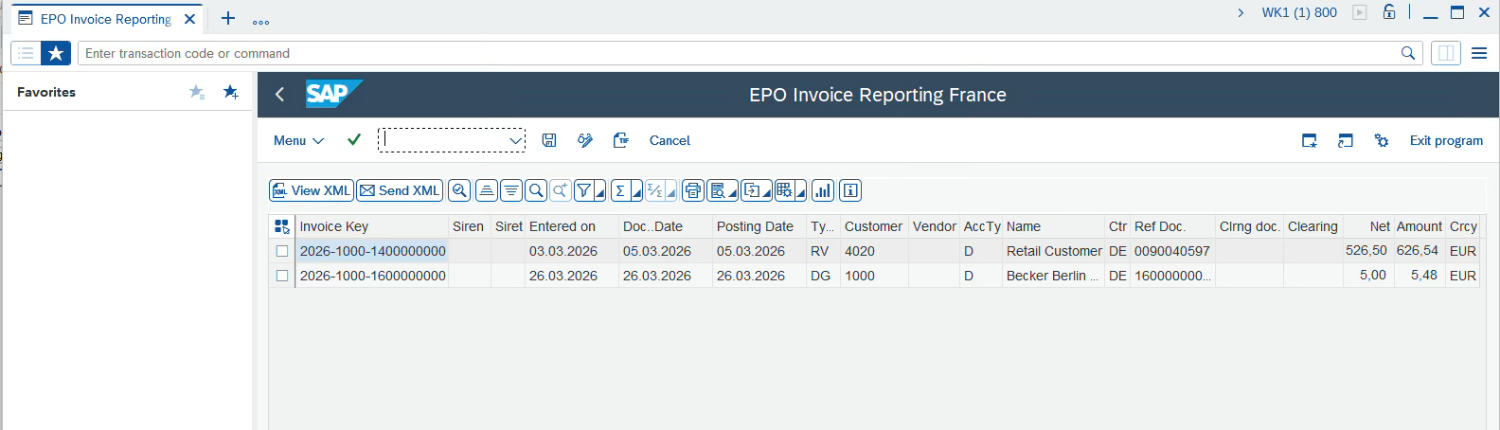
Periodic submission of all reportable transactions to the PA at the specified intervals. The solution selects the relevant documents directly from SAP, classifies them according to the reform criteria (cross-border B2B, B2C, exempt transactions) and generates the structured XML.

The EPO E-Reporting solution includes the following:

  • Automatic classification of outgoing and incoming documents, credit notes, reversals and adjustments based on their SAP data
  • Generation of AFNOR-compliant reporting files
  • Timely handover to the PA
  • Clear overview for manual checking and approval
Book a consultation now

Architecture: how EPO integrates with your SAP system

All the logic runs in ABAP on your SAP system: data selection, UBL mapping, XML generation and validation. The final step in the process – connecting to the French authorities – is handled by the EPO Connector, which links to a Plateforme Agréée of your choice.

Two options for the PA:

  1. Use EPO Partner-PA. We provide contractually bound, pre-certified Plateformes Agréées. You’ll be up and running in just a few weeks and won’t have to worry about choosing a provider or drawing up a contract.
  2. Please bring your own PA. If you already use one of over 100 accredited platforms (e.g. ecosio, Seeburger, Pagero, Sovos, Basware, Axway, Tradeshift), the EPO Connector integrates with it. No vendor lock-in, no duplicate contracts.

Why e-reporting with EPO Consulting is the best solution

  • Native to SAP and without any customisation: everything runs in ABAP, without any changes to the standard SAP system. Release upgrades and migrations remain unaffected.
  • No cloud requirement, no SAP DRC: no SAP BTP, no DRC licences, no mandatory use of an external cloud platform.
  • SAP ECC and SAP S/4: Compatible with SAP ECC 6.0 and all versions of SAP S/4, except the Public Cloud. Can also be used during an ongoing S/4 migration.
  • Provider-independent: You choose the Approved Platform.
  • E-invoicing trained since 2014: In live operation with international SAP customers and continuously being adapted to new countries and formats.
  • Support from Vienna: Personal, directly accessible, with no anonymous helpline.
Enquire now

Frequently asked questions – answered quickly

Generally speaking, yes, regarding the e-reporting obligation. For taxpayers not established in France, the e-reporting obligation has been postponed until September 2027. We strongly recommend that you have your specific circumstances reviewed on an individual basis.

A private platform accredited by the French government that is authorised to exchange e-invoices and transmit e-reporting data to the PPF. The term replaced the former term ‘PDP’ under the 2026 Finance Act.

No. EPO Consulting provides partner PAs. If necessary, you can switch to your own platform at any time; the EPO Connector supports both options.

Both. EPO can be used from ECC 6.0 onwards and is compatible with all S/4 versions except Public Cloud. Parallel operation is possible during an S/4 migration.

Yes. EPO meets the French requirements on its own and does not rely on SAP DRC.

This is realistic if the decision is made in the near future. The official DGFiP pilot phase has been running since the end of February and will continue until August 2026. Project durations range from a few weeks to a few months, depending on the scope.

The Finance Act 2026 has tightened the penalties. Specific amounts are subject to change and should be clarified with your tax adviser. Regardless of any fines, there are reputational and audit risks involved.

Ready for September 2026?

The DGFiP pilot phase is currently underway, with the requirement coming into force at the start of September 2026. Those who start now will have ample time for testing and a low-risk go-live. In a brief, no-obligation initial consultation, we will work with you to determine which of the two EPO modules is relevant to your SAP landscape and business model, and what a realistic roadmap to go-live would look like.

Doc-text Doc-text

DO YOU NEED MORE INFORMATION?

Either write to us using our contact form or contact our Sales Manager Manfred Trojan directly for a personal consultation.


Manfred Trojan

Sales Manager & Technical Assistent

E-Mail: manfred.trojan@epoconsulting.com

Phone: +43 670 404 9330

WordPress Cookie Notice by Real Cookie Banner