

Summary: It’s that easy to receive e-invoices
Since 1 January 2025, businesses in Germany must be able to receive structured XML e-invoices. EPO Consulting’s invoice register enables the legally compliant receipt, automated processing, validation, visualisation and integration of these invoices – including in conjunction with SAP. The solution supports various formats (UBL, CII, ZUGFeRD), can be used internationally and can be flexibly integrated into existing systems.
Automating e-invoice receipt in SAP
Companies worldwide are switching to structured e-invoices in XML format, often based on UBL XML or country-specific standards, whilst traditional PDF invoices are becoming less common. With the EPO Invoice Register, you can receive, verify and post e-invoices from all major markets centrally within your SAP system, combining global format support with maximum automation and legal compliance.
- E-invoices from all incoming channels
Email, web services, PEPPOL, EDI and file uploads are all consolidated centrally in the SAP Invoice Register. - Maximum automation
Structured XML data enables validation, order reconciliation and automated posting with significantly less manual intervention. - Support for global use and future-proof solutions
We support modern formats such as UBL and CII XML, as well as formats used to date, such as PDF and SAP IDocs.
Communication via the global PEPPOL network or via country-specific platforms such as KSeF, PPF, ZATCA and other e-invoicing platforms.
Why you need to – and should – switch to a new invoicing system now
In future, businesses must be able to receive structured e-invoices in XML format in accordance with EN 16931 – such as XRechnung, UBL or CII – electronically and process them fully automatically, whilst traditional PDFs are expressly no longer considered to be e-invoices.
For companies using SAP, the switch to structured e-invoices presents an opportunity to replace manual PDF processing, scattered email inboxes and siloed systems, thereby significantly reducing media breaks, OCR errors and time-consuming approval processes. When structured e-invoices arrive in the EPO invoice register, where they are automatically checked and posted, statutory requirements can be reliably met whilst simultaneously shortening processing times, reducing process costs and noticeably easing the workload on staff.
What is the EPO Incoming Invoices Register (REB)?
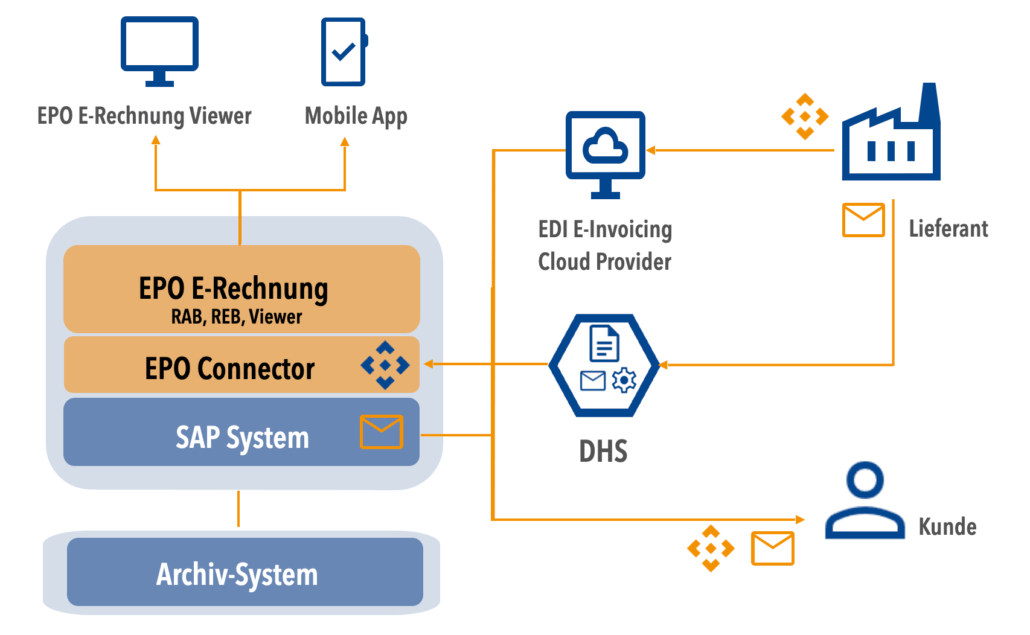
The EPO Invoice Receipt Book is the centralised solution for receiving, verifying and posting e-invoices directly into your SAP system. The REB acts as a centralised dashboard within the SAP system, consolidating all incoming invoices from mailboxes, portals, interfaces and other channels, so that structured XML e-invoices and traditional documents are both available within a single, unified interface.
Technically, EPO REB is fully integrated into SAP and works closely with interfaces via the EPO Connector, such as the Document Handling Server (DHS) for incoming emails. This creates a seamless end-to-end process: from receipt (via email, web service, PEPPOL or EDI), through validation, visualisation and approval, right through to posting in SAP. The entire process operates without the need for an additional external workflow platform or complex SAP workflow projects.
Various formats and channels – the EPO REB handles it all
By consolidating all incoming invoices in the EPO REB, there is no longer any need for the time-consuming management of various mailboxes, portals, channels or manual upload processes, and you gain a clear, comprehensive overview of all incoming invoices. At the same time, the REB handles both structured XML e-invoices and traditional documents, and – with filters, status information and drill-down options – ensures a high degree of clarity and enables you to find your way around quickly in your day-to-day work.
Benefits at a glance
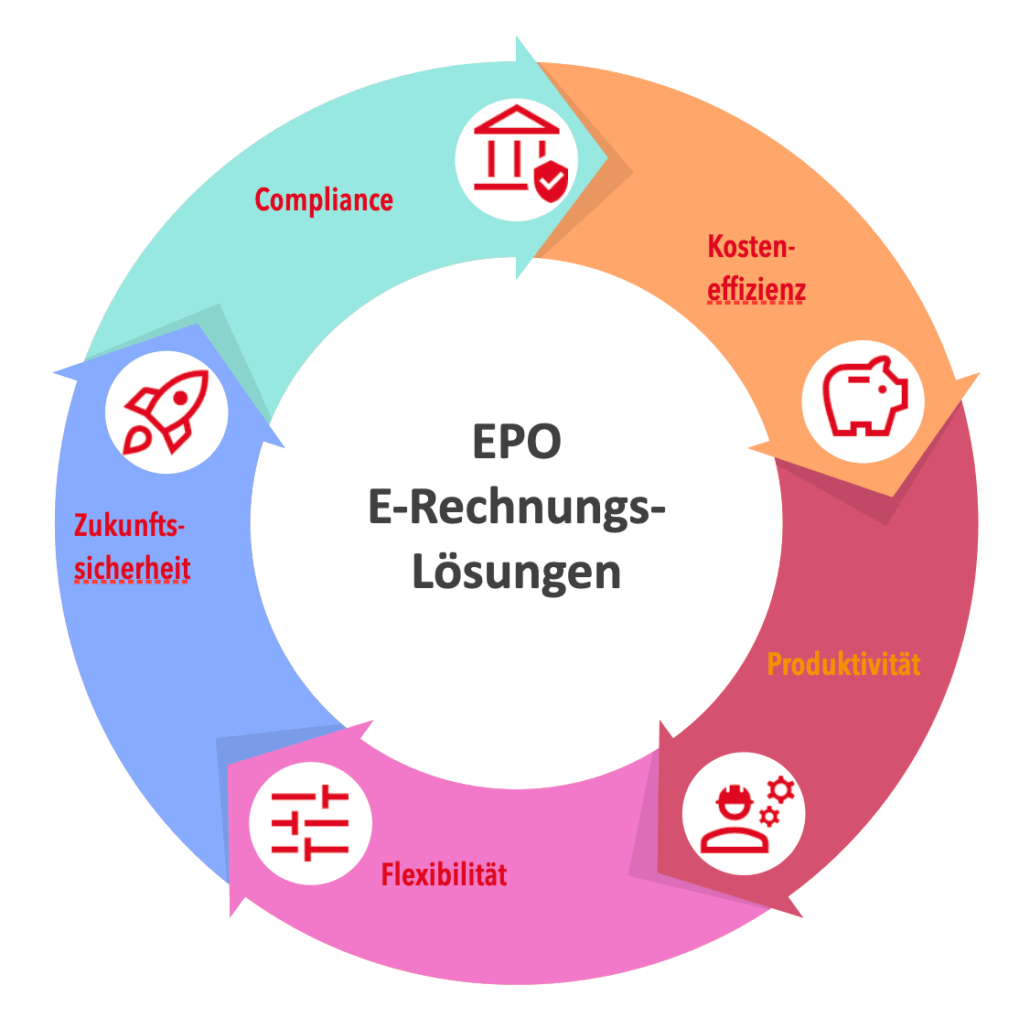
The EPO Invoice Register integrates e-invoice receipt with intelligent process automation directly within SAP, thereby significantly reducing manual effort and sources of error. At the same time, you benefit from a solution that not only complies with current legal requirements in Germany but is also suitable for meeting international requirements.
- Compliance with e-invoicing requirements in Germany, including EN 16931, XRechnung, UBL and CII, as well as support for other countries and formats.
- A high level of automation thanks to structured XML data, validation, UID checks and order reconciliation, right through to dark posting.
- Seamless integration into your existing SAP system, with a short project duration and without the need for additional external workflows.
- A centralised view of all incoming channels and document types, with a clear, functional overview for accounting and management accounting.
- Future-proof architecture, expandable to include a viewer, validator, process components and a mobile app for flexible approvals.
- Independent solution, available for all SAP releases
How the Incoming Invoices Register works
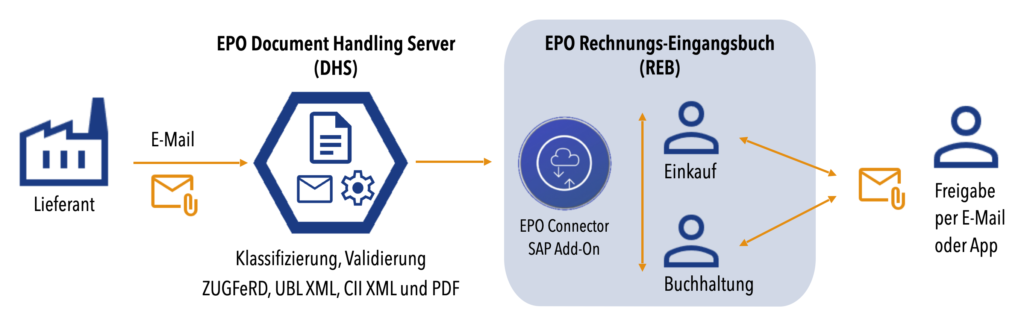
The EPO Invoice Register maps the entire e-invoicing process – from receipt to posting – in clearly structured steps directly within SAP. This creates a transparent, standardised workflow that efficiently processes both structured XML e-invoices and traditional PDF documents, enabling them to be posted at the touch of a button.
Receive invoices
Step 1
The EPO Invoice Register stores your invoices from all relevant channels, such as email (MS Exchange, IMAP), file directories, web services, PEPPOL or EDI.
For incoming emails, the company uses its own specially developed Document Handling Server.

For incoming data via the PEPPOL network or other interfaces, we can work with all major international providers.
This means that all e-invoices are stored centrally in the REB and are fully traceable right from the start.
Read invoice
Step 2
Structured e-invoices in accordance with EN 16931 are read entirely automatically and prepared for further processing. Unstructured documents such as PDFs, JPEGs or PNGs are recognised and classified using AI-supported OCR, and enriched with all relevant data such as line items, supplier details and dates. Alternatively, it is also possible to enter data manually directly into the invoice register.
Validate invoice
Step 3
The integrated XML validator checks X-invoices and other structured formats against the official standards. Validation ensures that incoming invoices are structurally correct. This means that incorrect invoices can be filtered out at this stage.
Try our EPO XRechnung Validator for free:
https://www.epoconsulting.com/en/einvoice-sap/e-invoice-validatorVisualise invoice
Step 4
The EPO E-Invoice Viewer converts XML e-invoices into an easy-to-read HTML view when they are opened and also displays embedded attachments in a structured format. This enables departments to check invoices conveniently without having to deal with XML structures and, if required, to work in multiple languages.
In addition to the invoice register, the visualisation is also available as a desktop, iOS and Android app.Try our EPO e-invoice viewer now for https://www.epoconsulting.com/en/einvoice-sap/e-invoice-viewer
Archive invoice
Step 5
All incoming invoices, whether e-invoices or PDFs, are archived via SAP ArchiveLink in the existing archiving system (e.g. ELO ECM, inPuncto, H&S, etc.).
Approve and post the invoice
Step 6
If there is an approved purchase order in SAP that matches the invoice, it can be posted automatically.
Alternatively, the invoice can be approved via a multi-stage approval process within the incoming invoice register, via an app or by email.Approval via email reply is available to all staff without any additional licence costs.
Approval and workflows directly in the invoice register
The EPO e-invoice register not only handles the technical receipt and validation of your e-invoices, but also, if required, maps the entire approval process directly within SAP. This eliminates the need for separate workflow systems or complex SAP workflow projects, which significantly simplifies implementation and operation.
Thanks to structured XML data, key checks such as company code identification via VAT number, reconciliation with suppliers created in SAP, and order number checks against existing SAP purchase orders can be carried out automatically. If all defined validation rules are met, invoices can be processed right through to automated posting without manual approval, whilst special cases continue to be handled via an approval workflow integrated into REB.
A mobile app is also available for all approval stages, enabling those responsible to view, comment on and approve invoices outside of SAP. This allows you to combine maximum automation with flexible, practical approval workflows, whilst maintaining transparency at all times regarding the status, responsibilities and history of each individual incoming invoice.
Automation as the greatest advantage
The greatest advantage of the EPO Incoming Invoice Register lies in the consistent use of structured e-invoice data for largely automated processing, rather than error-prone PDF and OCR processes. Whereas previously perhaps only a small proportion of incoming invoices could be processed automatically, the combination of validation, supplier and VAT number checks, and order reconciliation now enables a significantly higher rate of automated posting and a massive reduction in the workload involved in manual checks.
Suitable for international use and future-proof
The EPO Invoice Register is not only designed to meet the e-invoicing requirements in Germany, but also supports e-invoicing processes in all countries and for a wide range of formats. Via the PEPPOL network and connected e-invoicing providers, you can receive and process invoices in UBL XML format as well as country-specific formats such as KSeF in Poland, ZATCA in Saudi Arabia or PPF in France.
For your SAP environment, this means that you can securely receive, validate and post e-invoices from Germany, Europe and other markets using a single centralised solution. This ensures you remain flexible in the face of future legislative changes in other countries and benefit from a standardised, internationally scalable process for invoice receipt in SAP.
EPO Consulting: an experienced e-invoicing partner
EPO Consulting is one of the leading specialists in electronic invoicing and SAP-integrated solutions, with many years’ experience gained from numerous e-invoicing projects across various sectors. With EPO E-Invoicing for SAP and the Invoice Register, you receive a tried-and-tested solution that is continuously developed and optimised in real-world customer environments.
As such, the EPO Incoming Invoice Register represents the ideal alternative to SAP DRC for many companies. With the EPO Incoming Invoice Register, you can meet all your e-invoicing requirements quickly, flexibly and cost-effectively.
If you wish to receive e-invoices in SAP in a legally compliant manner and automate your invoice processing as much as possible, now is the right time to take the next step. Arrange a no-obligation consultation and let us show you how the EPO Invoice Register can get your e-invoice processing up and running in SAP within a few weeks.